Set it up once. Support DigiByte 24/7.

Why use DigiNode Tools?
Effortless menu-driven setup with set-it-and-forget-it simplicity.
No display, keyboard or mouse required - everything is managed remotely via the terminal.
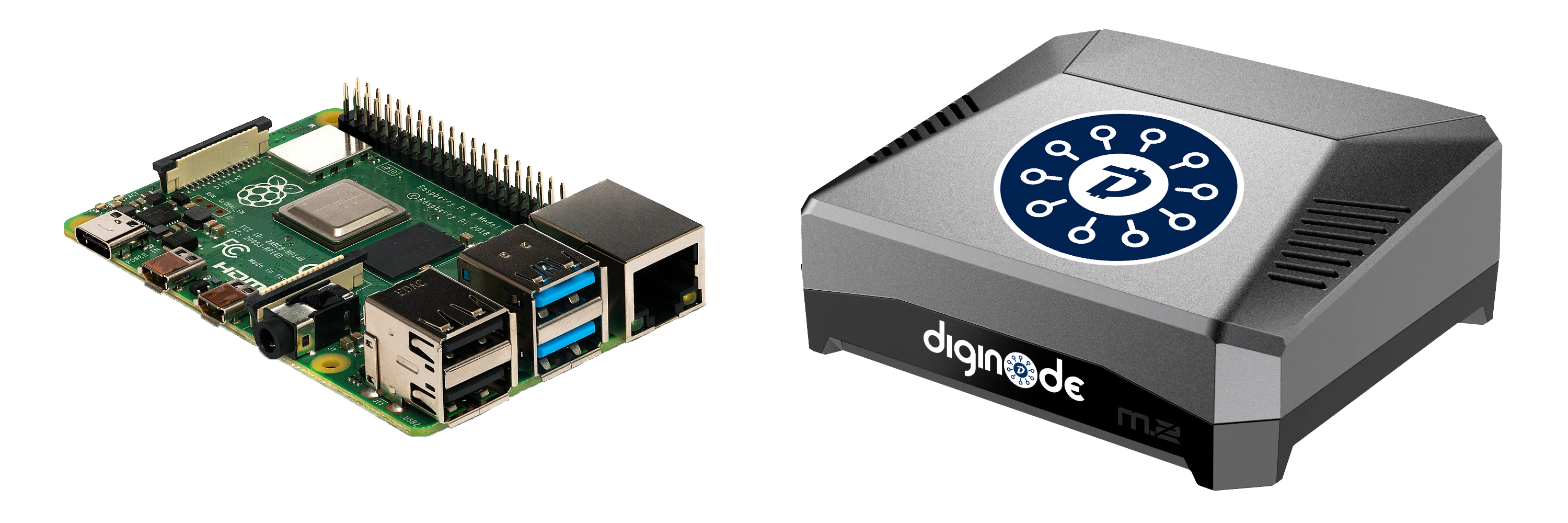
Works everywhere - install it on a device on your home network (e.g. Raspberry Pi) or in the cloud (e.g. VPS / VM / dedicated server).
Easy to use for less-technical users. Highly customizable for power users.
DigiNode Tools are free, and the code is public - review it on GitHub here.
DigiNode Tools are built in my spare time. Please sponsor me to support development, or donate DGB: dgb1qv8psxjeqkau5s35qwh75zy6kp95yhxxw0d3kup
Intuitively helps you set up a DigiByte Node
Almost no Linux command line experience required - the menu-driven setup is quick and easy.

Easy and Fast Menu-driven Setup
- Designed with less-technical users in mind - almost no Linux command-line experience required. Setup is entirely menu-driven.
- For Power Users, use launch flags to further customise your DigiNode setup (See Advanced Features).

Checks Hardware & OS Compatibility
- Automatically checks your system hardware and OS are compatible, and that there is sufficient disk space and memory.
- Checks for swap file, and helps create one on low memory devices.
- Optionally helps you create a 'digibyte' user account.

Run a DigiByte Mainnet node, a Testnet node, or both together
- Set up a DigiByte mainnet Node, a testnet Node, or a Dual Node - run both together side-by-side at the same time. A Dual Node needs at least 8GB RAM.
- By running a Dual Node (both Mainnet and Testnet together) you are contributing to the decentralization of the network, while also supporting developers building on DigiByte.

Automatic Software Configuration
- Automatically configures your DigiByte Node with optimal settings.
- Creates digibyte.conf with optimal settings. Sets up system services to keep your DigiNode running 24/7, even after a reboot.
- Optionally, use UPnP to automatically set up port forwarding.
Use DigiNode Dashboard to monitor your DigiNode
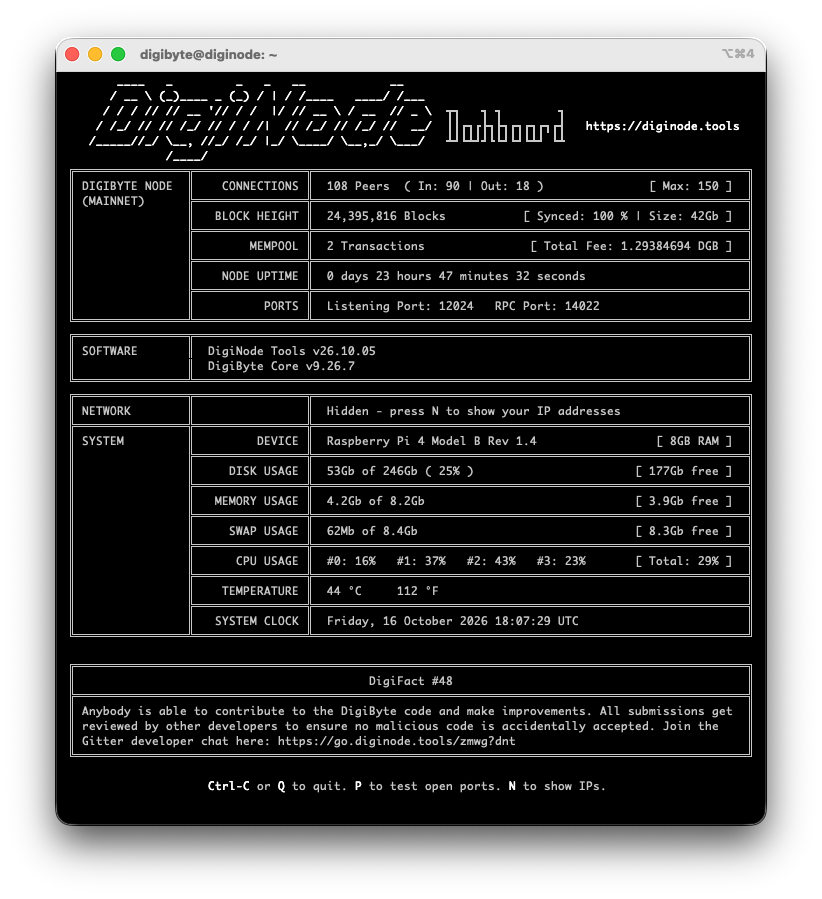
DigiNode Dashboard makes it easy to monitor the status of your DigiByte Node

DigiNode Dashboard
- Monitor your DigiNode via the command line, over SSH, to quickly check that your DigiByte Node is running smoothly.
- DigiNode Dashboard displays node status, system usage (temperature, disk space, RAM, swap and CPU), and automatically notifies you of available software updates.

Port Tester
- Use the integrated Port Tester to quickly check that your DigiByte ports are being forwarded correctly
Easily manage, upgrade and back up your DigiNode
DigiNode Tools make it easy to manage every aspect of your DigiByte Node.

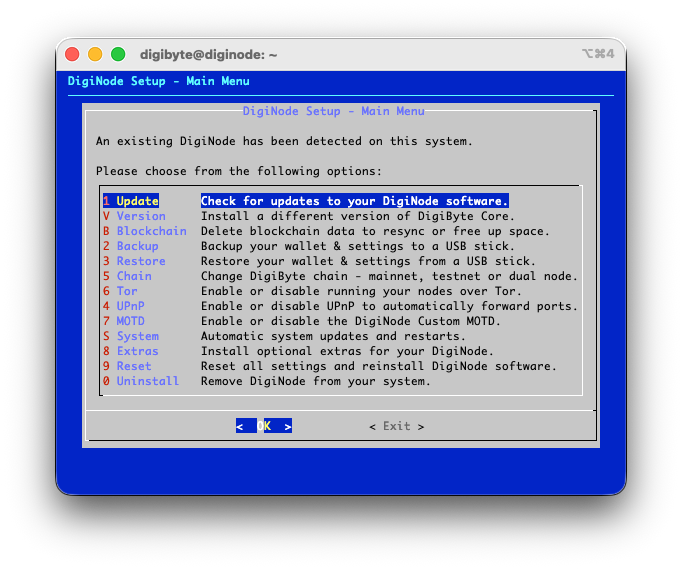
Manage your DigiNode
- Menu-driven management for your DigiByte Node software.
- Install updates, switch DigiByte chains, enable/disable UPnP for Port Forwarding, enable/disable DigiNode MOTD, install Extras (fan software), uninstall/reset and more. (See Additional Features.)
- Once installed, enter
diginode-setupto manage your DigiNode

Software Updates
- Quickly and easily upgrade DigiNode Tools and DigiByte Core to the latest release.
- Allows complete control - install updates all together or individually.
- Easily upgrade and downgrade the latest DigiByte release to/from a DigiByte pre-release. (See Advanced Features)
- Choose which version of DigiByte Core to run - upgrade or downgrade to any verified version, back to v7.17.2.

Backup & Restore
- Save your DigiByte wallet to a USB stick for safe keeping, and easily restore it later.
- Backup feature can also be used to migrate your DigiNode to a new device.

Command Line Interface
- Look up your DigiByte Node peers, view the log files, and stop/restart your node using the DigiNode CLI.
- Enter
diginode --helpto see a list of commands you can use to manage your DigiNode.
DigiNode Tools has many more powerful features to make setting up and managing a DigiNode a breeze.
Start DigiNode Setup
Raspberry Pi users should follow the instructions here.
For Ubuntu / Debian, paste this command into the terminal:
- Ubuntu Server 64-bit is recommended. For Debian, you will need to first install sudo. See System Requirements for more info.
- It is recommended to create a new user account called 'digibyte' for your DigiNode. This will isolate your wallet in its own user account.
- Run the setup command as user: 'digibyte' (Do not run as root).
- Windows Terminal is recommended for Windows. iTerm2 is recommended for Mac.
- To customize your DigiNode, see Advanced Features.
- Disclaimer: These tools are provided as is. Use at your own risk. Olly Stedall cannot be held liable for any loss of DGB. Always keep a backup of your DigiByte wallet.